


What is a market bubble?
A beginner's guide to spotting and understanding market bubbles.
* Trading is risky. Your capital is at risk.
Prices rise fast. Fortunes are made. Then, a sudden, brutal crash. This is the life cycle of a market bubble.
It's a pattern that has repeated for centuries, from tulip bulbs in the 1600s, to the dot-com boom of the late 1990s. Understanding this phenomenon is crucial for any trader looking to navigate the financial markets successfully.
This article breaks down exactly what a market bubble is, why they happen, and how you can learn to spot the warning signs.
Key takeaways
Success in the forex market means understanding the fundamentals, picking the right broker and platform, and building a strong trading plan.
Managing risks is key in forex trading. Using stop loss and take profit orders is vital to safeguard investments.
Managing risks is key in forex trading. Using stop loss and take profit orders is vital to safeguard investments.
What is a market bubble?
A market bubble is an economic cycle where asset prices experience a rapid increase, disconnected from their intrinsic or fundamental value.
This surge is fuelled by enthusiastic and often misguided speculation. Put simply, people buy assets not because they believe they are worth the high price, but because they expect to sell them to someone else for an even higher price later.
It creates a self-feeding loop. Rising prices attract more buyers, which pushes prices higher still, creating a wave of market euphoria. Eventually, reality sets in. The bubble 'bursts,' and prices come crashing down, often much faster than they rose.
This isn't just about high valuations. A key feature of a market bubble is the story behind it. Investors convince themselves and each other that "this time is different," and that a new technology or a new paradigm justifies the sky-high prices. This belief makes it incredibly difficult to see a bubble when you are inside one.
The five stages of a market bubble
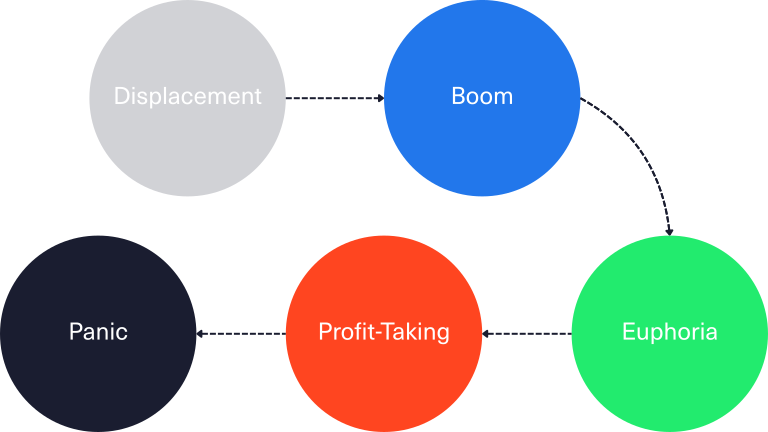
Economist Hyman Minsky developed a framework that outlines the typical five stages of a market bubble. Understanding this pattern can help you identify where we might be in a cycle.
- Displacement: A new event or innovation captures the market's imagination. It could be a groundbreaking technology like the internet or a major shift in economic policy, like very low interest rates. This 'displacement' creates the promise of future profits.
- Boom: Prices begin to rise slowly at first, then gain momentum. Media attention grows, and early investors start to see significant returns. This attracts more participants, adding fuel to the fire.
- Euphoria: This is the peak of speculative fever. Caution is thrown to the wind. Prices go vertical as the fear of missing out (FOMO) takes hold. You'll hear phrases like "new paradigm" used to justify valuations that make no sense based on traditional metrics. This is when the general public, often the least experienced investors, typically jump in.
- Profit-Taking: The smart money, and those who sense the end is near, begin to sell their positions and lock in profits. The price rise stalls and may dip, but many still believe it's just a temporary pullback before the next leg up.
- Panic: Reality hits. A catalyst, perhaps a major company collapse or a shift in policy, pricks the bubble. Everyone rushes for the exit at once. Buyers disappear, and prices plummet. This phase is often marked by margin calls and forced selling, which accelerates the crash.
Market bubble myths
Many misconceptions surround market bubbles, often costing traders and investors dearly.
Let's take a look at some of the most common.
Myth: "You can time the market"
Everyone believes they will be smart enough to get out just before the top. In reality, this is almost impossible. Timing a bubble requires you to be right twice: when to sell and when to buy back in. Most people fail at both, holding on all the way down.
Myth: "Smart people don't get caught"
History proves this wrong. Sir Isaac Newton, one of the greatest minds ever, lost a fortune in the South Sea Bubble of 1720. He famously said he could "calculate the movements of the stars, but not the madness of men." Intelligence is no defence against herd behaviour.
Myth: "This time is different"
These are often called the four most expensive words in investing. Every bubble is accompanied by a narrative explaining why old valuation rules no longer apply. While the innovation might be real (the internet was truly transformative), it doesn't mean prices can become completely unhinged from reality forever.
The behavioural psychology of bubbles
Bubbles are fundamentally human phenomena. They are driven by powerful psychological biases that affect us all. Four of the biggest mental factors are:
- FOMO
- Herd mentality
- Overconfidence
- Confirmation Bias
Fear of Missing Out (FOMO)
Perhaps the most potent driver of market bubbles, FOMO creates intense pressure to join in when we see others getting rich. This often leads to emotionally charged decisions, usually at the worst possible time right when risk is at its peak.
Herd Mentality
As social creatures, we tend to follow the crowd. When we see a large group of people investing in something, like a particular stock, we assume they must have insider knowledge. This creates a feedback loop where collective buying leads to more buying, replacing individual analysis with widespread euphoria.
Overconfidence
Early wins in a bubble often feel like skill but are usually just luck. This overconfidence can push investors to take bigger risks, use leverage, and abandon diversification, just as the market is reaching its peak.
Confirmation Bias
We naturally seek out information that supports our beliefs and ignore anything that contradicts them. For example, if you believe in the potential of an AI market bubble, you'll focus on positive news about its growth while dismissing concerns about high valuations or slowing development.
How to identify a potential market bubble
While no single metric is foolproof, several indicators can signal that a market is becoming dangerously overvalued.
Valuation metrics
These are necessary but not always sufficient. A market can stay "expensive" for years.
- Shiller CAPE Ratio: Compares current stock prices to average earnings over the past 10 years, adjusted for inflation. Historically, readings above 30 have signalled stretched valuations. The peak in 2000 was 44.
- Price-to-Earnings (P/E) Ratio: A high forward P/E suggests investors are expecting very strong earnings growth. The S&P 500's P/E hit 32x in the dot-com bubble.
- Buffett Indicator: The total market capitalisation of all stocks divided by the country's GDP. Warren Buffett has called this "the best single measure of where valuations stand at any given moment." A level over 150% is a warning sign.
Non-valuation warning signs
These can be more predictive of an impending bust.
- Market Breadth Deteriorates: The rally becomes concentrated in just a few mega-cap stocks, while the majority of stocks lag behind. In 2024, only 30% of stocks in the Russell 1000 index outperformed the index itself, showing a narrow, fragile rally.
- A Surge in IPOs: Companies rush to go public to cash in on the euphoric sentiment. High 'day-one pops,' where a stock soars on its first day of trading, are a classic sign of speculative excess.
- Narrative Replaces Analysis: The conversation shifts from earnings and revenue to transformative potential and abstract concepts. Financial metrics are dismissed in favour of 'storytelling' metrics. An example could be valuing an AI company based on its "potential user base" instead of its profits.

Market bubbles from history
History provides the best lessons. The pattern repeats with startling regularity.
Let's take a quick look at three of the most famous bubbles from history.
The Dot-Com Bubble (1995-2000)
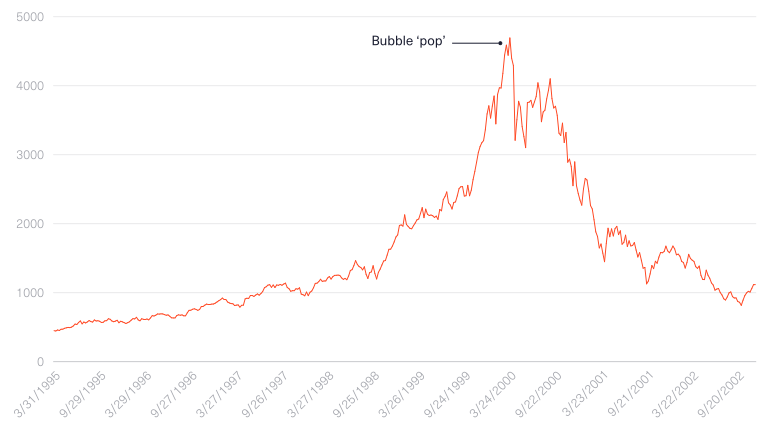
The birth of the public internet created a powerful narrative of endless growth. Investors poured money into any company with ".com" in its name, often with no revenue or business plan. The NASDAQ index soared over 600% in five years. When the bubble burst in 2000, the NASDAQ fell 78% and took 15 years to recover its previous high. The internet was real, but the valuations were not. This is a classic example of an equity market bubble.
NASDAQ 100 Composite Index 1995-2002
The U.S. Housing Bubble (2003-2007)
Following the dot-com bust, low interest rates made borrowing cheap. Combined with lax lending standards, this fuelled a massive bubble in property prices. The belief that "house prices only go up" became widespread. Complex financial products hid the underlying risks. When homeowners began defaulting on subprime mortgages, the entire global financial system seized up, leading to the Great Recession of 2008. Housing prices in the US fell 33% nationally.
Tulipmania (1636-1637)
Even in the 17th century, the pattern was clear. Tulips, a new luxury item in the Netherlands, became a speculative obsession. At the peak, a single rare bulb could be worth more than a house. A futures market developed, allowing people to trade bulbs that hadn't even been grown yet. In 1637, the market collapsed suddenly, with prices falling over 99%, wiping out fortunes overnight.
Frequently asked questions
A market bubble occurs when the price of an asset, like stocks or property, rises rapidly to a level far beyond its fundamental value.
This surge is typically driven by enthusiastic speculation and herd behaviour, where people buy simply because they expect prices to keep rising, not because the asset is worth the high price.
After a market bubble bursts, a rapid and often severe price crash follows. This can have several consequences:
- Panic Selling: Investors rush to sell their assets to limit their losses, pushing prices down even further.
- Wealth Destruction: The value of investment portfolios, retirement funds, and property can fall dramatically, impacting household wealth.
- Economic Recession: A major crash can lead to a wider economic downturn. Businesses may struggle to get credit, leading to job losses and reduced consumer spending.
- New Opportunities: For strategic investors, a crash can present opportunities to buy valuable assets at heavily discounted prices once the panic has died down.
While there have been many significant market bubbles, the Dot-Com Bubble of the late 1990s is one of the most famous examples of a stock market bubble.
During this period, investors poured money into internet-based companies, many of which had no solid business plan or revenue. The hype around the new "internet age" drove valuations to extreme levels.
When the bubble burst between 2000 and 2002, the NASDAQ index fell by nearly 78%, wiping out trillions in market value and leading to the failure of many tech companies.
The bottom line
A market bubble is a powerful force, driven by a compelling story and human emotion. While the prospect of quick riches is tempting, history shows they almost always end in a painful crash. For beginner traders, the lesson is not to try and ride the wave and time the exit.
The key is to remain disciplined. Focus on fundamental value, manage your risk carefully, and resist the urge to follow the herd. By understanding the psychology and patterns behind bubbles, you can learn to protect your capital and make smarter, more sustainable trading decisions.
Ready to build a solid foundation for your trading journey? Explore our educational resources to learn more about risk management and fundamental analysis.