


Are we in an AI bubble?
* Trading is risky. Your capital is at risk.
Boom or bubble? That is the big question.
Everywhere you look, from news headlines to social media, the conversation is about Artificial Intelligence. Share prices for AI-related companies have soared, creating immense wealth for early investors. But it also raises a crucial question for every trader: are we witnessing a genuine technological revolution, or are we inside a classic market bubble destined to burst?
In this blog, we'll examine the arguments for and against an AI bubble to help you navigate today's financial markets.
Key takeaways
The market is at a crossroads, with strong arguments for both a sustainable AI boom and a speculative AI bubble.
The 'bull case' points to real earnings growth, strong company balance sheets, and genuine productivity gains from AI technology.
The 'bear case' highlights stretched valuations similar to the dot-com era, hype-driven investing, and unprecedented concentration in a few tech giants.
Recognising the market cycle stage, even if you can't time the peak, is key to managing risk.
Are we in a market bubble?
Before we can determine if we are in an AI bubble, it’s important to understand what a market bubble is. As we explored in our guide, What is a Market Bubble? it's a period where asset prices rocket far beyond their fundamental value, driven by speculation instead of solid financial performance.
Today's market presents a confusing picture. Some data points suggest we're in a rational, earnings-driven boom. Others flash warning signs that have historically preceded major crashes.
Let's take a look at both sides of the argument.
The Bull Case: A sustainable boom
Those who believe we are not in a bubble point to strong underlying fundamentals, such as consistent revenue growth, widespread adoption of groundbreaking technologies, and robust market demand.
They argue that what might appear as inflated valuations or excessive enthusiasm is, in reality, a logical response to the transformational impact of a technological revolution. From advancements in artificial intelligence to the rapid evolution of clean energy solutions, these innovations are reshaping industries and creating new opportunities, justifying the optimism.
According to this perspective, the current market activity reflects a rational belief in the long-term potential of these disruptive technologies, rather than speculative mania.
Here are few reasons why we might NOT be in a bubble:
- Earnings Are Real and Growing: Unlike the dot-com era, today's tech giants are immensely profitable. Forecasts predict earnings growth of around 12.9% over the next 12 months. Prices are rising, but so are profits, justifying higher valuations.
- Fortress Balance Sheets: Companies like Microsoft and Google have huge cash reserves and minimal debt. This financial strength is a world away from the cash-burning start-ups of the late 1990s, making them far more resilient to economic shocks.
- Genuine Productivity Gains: AI is not just a concept; it is already being used to make businesses more efficient, cut costs, and create new products. These productivity gains can drive economic growth and corporate profits for years to come, supporting a long-term bull market.
NASDAQ Composite Index YTD
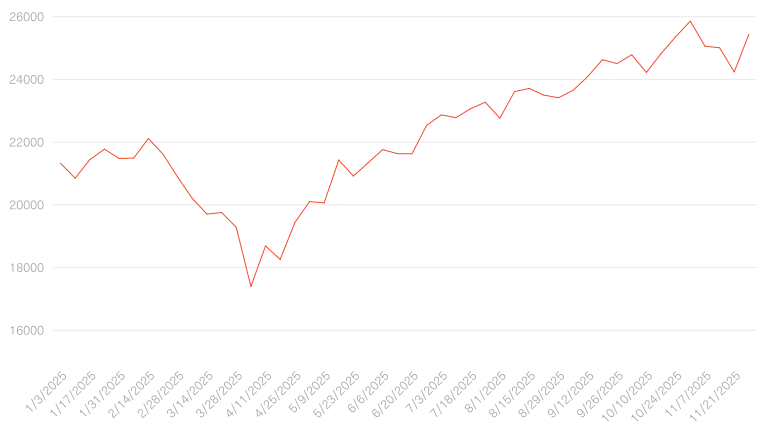
The tech-heavy NASDAQ index is up over 19% since the start of the year.
The Bear Case: A classic bubble

On the other side of the debate are the bears, who see classic signs of a speculative bubble forming, particularly an AI bubble.
They argue that the rapid influx of investment, skyrocketing valuations, and hype surrounding artificial intelligence are disconnected from the technology's current capabilities and real-world applications.
According to this perspective, the AI sector is being driven more by fear of missing out (FOMO) and market speculation than by sustainable growth or proven profitability. These skeptics warn that, without tangible results to back the optimism, the bubble could burst, leading to significant losses for investors and slowing down progress in the industry as a whole.
Here are the main warning signs:
- Valuations Scream Overextension: Certain metrics are at levels last seen just before major crashes. The Shiller CAPE ratio, which measures long-term valuation, is over 30 - a level that coincided with the 2000 dot-com peak. Similarly, the Buffet Indicator which measures stock market capitalisation divided by the country's GDP is over 200%.
- Narrative Replaces Financials: In a bubble, the story becomes more important than the numbers. We are seeing this today, as some AI companies with huge losses are given massive valuations. OpenAI, for example, was reportedly valued at over $100B despite burning through cash. Even its CEO, Sam Altman, has warned of a potential AI bubble, noting the disconnect between hype and reality. When investors focus on "model parameters" instead of profit margins, it's a historical warning sign.
- Euphoria Signals Are Flashing: Speculative behaviour is becoming common. We're seeing a surge in new company listings (IPOs), with many soaring 30% or more on their first day of trading. This mirrors the mania of the late 1990s, suggesting that fear of missing out (FOMO) is overtaking rational analysis.
Shiller CAPE Ratio 2023-2025
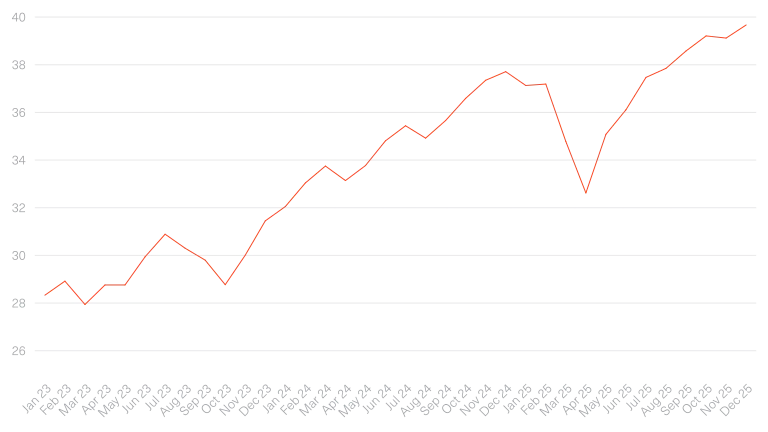
The Shiller CAPE ratio has remained above the historically significant 30 benchmark since the start of 2024.
AI within the broader bubble
The debate becomes sharpest when we focus on AI itself. The technology is undeniably transformative, just as the internet was. But real innovation is often what enables a bubble, rather than preventing it.
The biggest risk is concentration. A small group of companies, known as the "Magnificent Seven" (Microsoft, Apple, Google, Amazon, Nvidia, Meta, and Tesla), now make up around a third of the S&P 500's total value. This is the highest market concentration in decades.
S&P 500 Weighting December 2025

These companies are all heavily invested in the AI race. This creates two problems. First, if these few stocks falter, they could drag the entire market down with them. Second, their fates are deeply interconnected.
For instance, Nvidia, which makes essential AI chips, has provided discounts to companies like OpenAI in exchange for equity. This creates a circular logic where the valuation of one company is based on the success of another, amplifying risk across the system. Should an AI bubble burst, the fallout could be widespread.
Minsky's 5 stages: Where are we now?
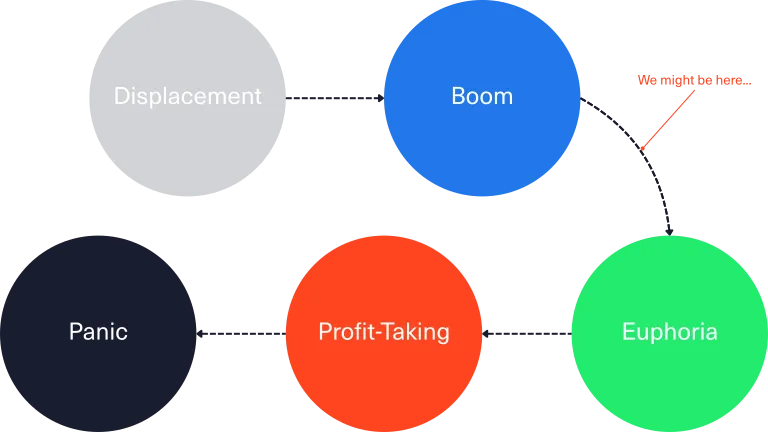
The economist Hyman Minsky outlined a five-stage lifecycle for a typical market bubble. Pinpointing our current position can help us understand the risks.
- Displacement: A new, exciting development appears. For us, this was the emergence of generative AI, which captured the world's imagination.
- Boom: Prices start to rise, attracting more and more investors. Media coverage intensifies. We are firmly in this phase, with AI stock market valuations climbing steadily.
- Euphoria: This is the peak of the frenzy. Prices go vertical, and caution is abandoned. While there are signs of euphoria, we may not be at the absolute peak yet. Investor sentiment surveys are not yet at the extreme levels seen before past crashes.
- Financial Distress: Insiders and smart investors start to sell. Prices level off. This phase is usually triggered by an unexpected shock.
- Revulsion: Panic sets in, and everyone tries to sell at once. An AI bubble burst would mark the start of this stage.
Based on this framework, we are likely in the later stages of the boom, approaching euphoria. This means that while there could still be further upside, the risk of a sharp correction is growing daily.
The bottom line
So, is AI a bubble? The honest answer is that it's complicated. There are genuine, fundamental reasons for optimism about AI and the companies leading the charge. But there are also clear signs of speculative excess and herd behaviour that have historically ended in tears. The market is walking a tightrope between a tech-driven boom and a hype-driven bubble.
For you as a trader, the most important thing is not to try and perfectly time the peak or predict the AI bubble burst. That's a nearly impossible task. Instead, focus on what you can control: risk management. Understand the arguments, stay informed, and avoid making emotional decisions based on hype or FOMO.
Building a solid trading strategy based on knowledge, not speculation, is the best way to navigate uncertain markets.
Ready to learn more and strengthen your trading skills? Explore our library of educational materials to master risk management and fundamental analysis.