


ABC patterns in trading: A strategy guide
Learn how to spot and take advantage of ABC patterns.
* Trading is risky. Your capital is at risk.
Want to predict market moves with ease? Mastering ABC patterns is a powerful skill that enables traders to identify and capitalise on market movements with confidence and precision.
These patterns, rooted in technical analysis, provide valuable insights into market trends, helping you anticipate potential price reversals or continuations before they unfold.
In this comprehensive beginner's guide, you'll gain a clear understanding of what ABC patterns are, why they matter, and how to effectively incorporate them into your trading strategy.
Whether you're just starting out or looking to refine your approach, this guide will equip you with the knowledge and tools needed to navigate the markets with greater clarity and success.
Key takeaways
Success in the forex market means understanding the fundamentals, picking the right broker and platform, and building a strong trading plan.
Managing risks is key in forex trading. Using stop loss and take profit orders is vital to safeguard investments.
How to trade forex using ABC patterns
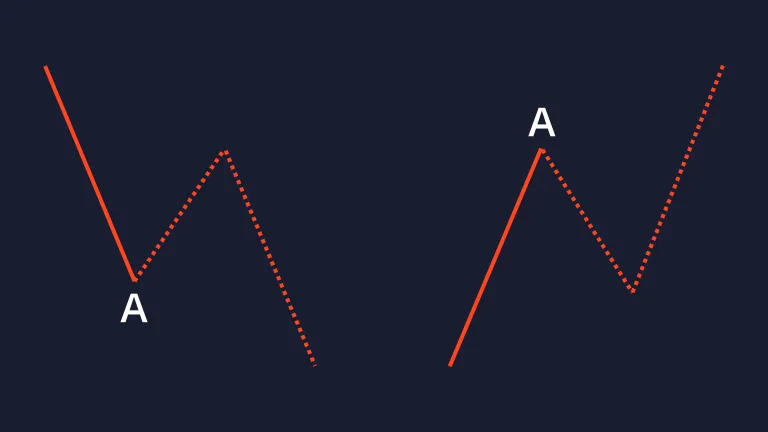
Trading with ABC patterns involves identifying the three pivotal points: A, B, and C:
- A new price move starts.
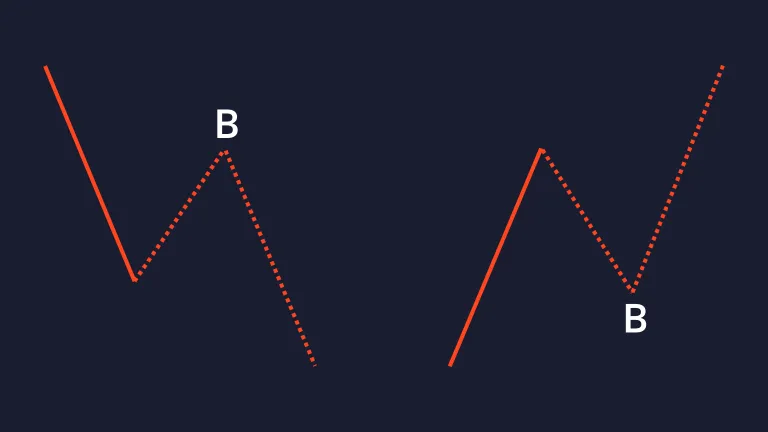
- The price retraces without surpassing point A's starting level.
- The retracement from B end and the initial trend from A to B resumes.
A new trend begins...
Point A marks the inception of a significant price movement, setting the stage for a potential high-yield trade - it's where discerning traders keenly focus their attention to anticipate future market trends.
The price reverses (but doesn’t cross ‘A’...)
Point A marks the inception of a significant price movement, setting the stage for a potential high-yield trade - it's where discerning traders keenly focus their attention to anticipate future market trends.
The trend resumes
Finally, at C, the market narrative takes a decisive turn. Here, the retracement that commenced at B concludes, and the price movement from A to B resumes with renewed vigour.
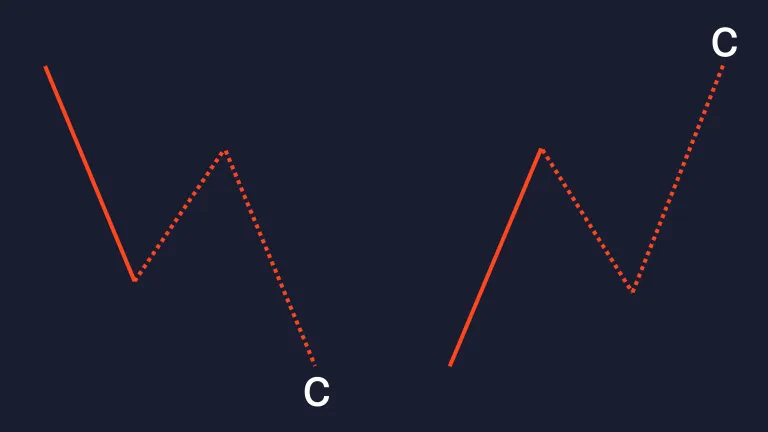
This is a tell-tale sign for the astute trader, indicating that the time is ripe to capitalise on the resilience of the market's original impetus.
Think of C as the catalyst that sparks action, opening up opportunities for those who can see it as a sign that the market is ready to follow a trend. By carefully evaluating C, traders can make better decisions and position themselves to potentially benefit from a trend resurgence.
Understanding the dynamics at C will sharpen your trading skills, helping you navigate the markets with confidence and finesse.
To effectively use these patterns, you need to carefully observe the price swings and identify the key points with precision. It's also a good idea to use technical indicators for confirmation to make your observations more reliable.
Another thing to consider is practicing on historical data, as it helps improve pattern recognition. And don't forget to set strict stop-loss orders to protect your capital from unexpected market movements.
For the best trading execution, wait for the pattern to fully form. Entering trades too early at point B can sometimes make you misinterpret market corrections as ABC pattern formations.
Examples of ABC pattern trades
Success in ABC pattern trades is often through experience and comprehensive market knowledge. For instance, studying a previous EUR/USD trade might reveal a pronounced ABC pattern during a news release, when the market retested a significant level at point B before continuing the trend to C, yielding a profitable opportunity for sharp traders.
Here's quick example of what this might look like in the real world:
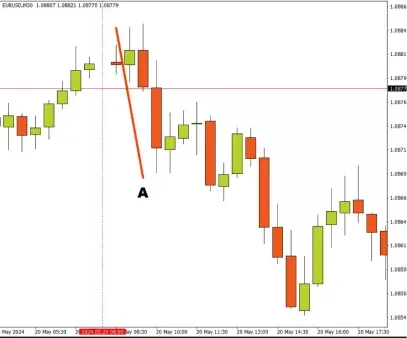
Imagine you sit down to start trading EUR/USD at 8:00AM one Monday morning. The currency pair shows potential as it starts at 1.1400, signalling an uptrend - 'A' in the pattern.
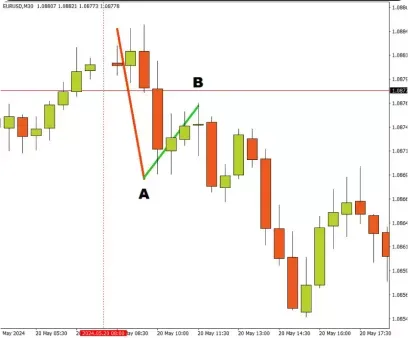
By 10:30 AM, it peaks at 1.1550, followed by a dip to 1.1500 by noon - this is point 'B', retracement.
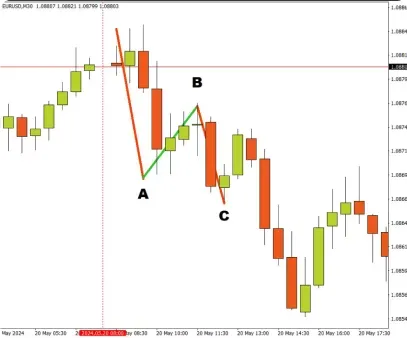
At 1:00 PM, Point C appears, and EUR/USD resumes its ascent, closing at 1.1620 by 4:00 PM.
Choosing the right ABC trading strategy
Your ABC trading strategy should align with the nuances of forex markets. It's important to consider market analysis factors like volatility triggered by geopolitical events, especially in developing regions where market responses can be dynamic and swift.
Let's take a look at some common strategies used in trading ABC patterns:
The bullish ABC pattern strategy:
This one works well in uptrends. You can buy at point C and aim for higher highs. Remember to control your risk by placing stop-loss orders below point A.
The bearish ABC pattern strategy:
This is suitable for downtrends. Sell at point C and aim for lower lows. Place stop-loss orders above point.
The breakout ABC pattern strategy:
This is effective when you expect the price to break out of a resistance or support level. Wait for confirmation at point C before entering your trade in the direction of the breakout.
The range-bound ABC pattern strategy:
If you're dealing with a range-bound market, you can identify both bullish and bearish patterns to trade within the established range. For instance, aim for short positions near point B and long positions near point A.
The combined ABC pattern strategy:
This involves combining different technical indicators like moving averages or stochastic indicators to confirm the ABC pattern. This helps reduce the risk of false signals and increase the probability of successful trades. Remember, being aware of these strategies can help you navigate the forex markets more effectively!
Key advantages of ABC trading

ABC patterns offer a structured approach to trading, with clear entry, stop-loss, and take-profit levels. They can be applied in various time frames and, once mastered, enable traders to forecast market swings with considerable accuracy.
Some other benefits of incorporating ABC patterns into your trading strategy include:
Providing a roadmap for defining market trends.
Offering high-risk reward ratios.
Identifying potential entry and exit points.ng high-risk reward ratios.
Enhancing overall trading discipline and decision-making.
Common mistakes in ABC pattern trading

Novice traders often fall prey to errors such as mistaking market noise for a true ABC pattern or misplacing their stop-loss and take-profit. To avoid these pitfalls, traders must conduct a thorough analysis and adhere to disciplined risk management practices.
Some common mistakes to avoid when trading ABC patterns include:
Entering trades too early without confirmation at point C.
Not setting stop-loss orders or placing them too far away from point A.
Failing to adjust take-profit levels according to market conditions.
Ignoring other technical indicators that could further confirm the pattern.
Monitoring your ABC trading performance

Keeping a detailed record of trades can help identify the effectiveness of your ABC pattern strategy. Monitoring your performance will also help you identify areas for improvement and fine-tune your approach
To track your ABC pattern trading performance, consider the following:
Maintaining a trading journal that records entry and exit points, as well as any technical indicators used.
Tracking the success rate of your trades and adjusting strategies accordingly.
Reviewing previous trades to learn from both successes and refine your strategy continuously.
Frequently asked questions
The ABC pattern is a popular chart pattern used in technical analysis, which represents a price correction within a prevailing trend. It consists of three legs: the A-B leg, the B-C leg, and the underlying trend, often called the 5-3-5 sequence.
No chart pattern is 100% reliable, and the ABC pattern is no exception. It's essential to use it in conjunction with other technical analysis tools and indicators to increase its reliability.
When analysing a sell pattern, in the move from point A to B, the market should not go beyond either A or B. In the move from B to C, the market should not go beyond either B or C. In a bullish ABC pattern, point C must be lower than A.
In a bearish trend, point A will be significantly low, and point B will be far higher. There is no other point higher or lower between A and B. Point C will then form above A, and the distance between B to C is 61.8 or 78.6% of AB.
The bottom line
ABC patterns can be a game-changer for forex traders, whether you're just starting out or you're at an intermediate level. When used wisely, they become a powerful tool in your trading arsenal. Mastering ABC pattern trades requires not only knowledge and experience but also a strategic approach that combines confidence with practicality.